


16 September 2026
Key Takeaways
- Custom lens assemblies divide into three procurement routes: supply from catalogue, a requalified variant of a standard chassis, or a new optical design. The route is determined by which parameters differ from the catalogue, not by how demanding the specification appears.
- Envelope parameters: operating temperature, vibration category, sealing, mechanical interface, can usually be absorbed by a variant. Prescription parameters: focal range, waveband, aperture, image format, require optical redesign and the non-recurring cost that follows.
- A boresight or MTF figure may represent design intent, a typical value or a verified production tolerance. Only the third tells an integrator what to reserve in the system pointing budget, so establish which you are being quoted, across what mechanism range, and on what basis it is verified.
- Extending environmental range is paid for in boresight allowance, and holding zoom timing through a cold soak is paid for in electrical power. A supplier offering extended range without raising either should be questioned.
- Export status and design ownership are first-conversation matters, not last. Beck's assemblies are ITAR-free, removing one class of constraint at the outset.
Three Routes, and What Decides Between Them
You have a requirement for a ruggedised lens system in a harsh environment. Setting export compliance aside for a moment, there are three affirmative answers: yes, from a catalogue of pre-engineered assemblies; yes, as a variant of one; or yes, as a development programme. They differ however, by orders of magnitude in cost and schedule, and the choice between them is usually settled before a quotation exists.
Requirements rather than preferences are critical:
- Temperature range.
- Pointing budget.
- Focal length.
- Mounting interface.
- Vibration category.
Where those can be met by a pre-engineered assembly, they are. Where they cannot, an existing baseline is reconfigured and requalified. Where the parameters differ sufficiently that the optical prescription changes, the project turns into a design exercise rather than a more straightforward modification.
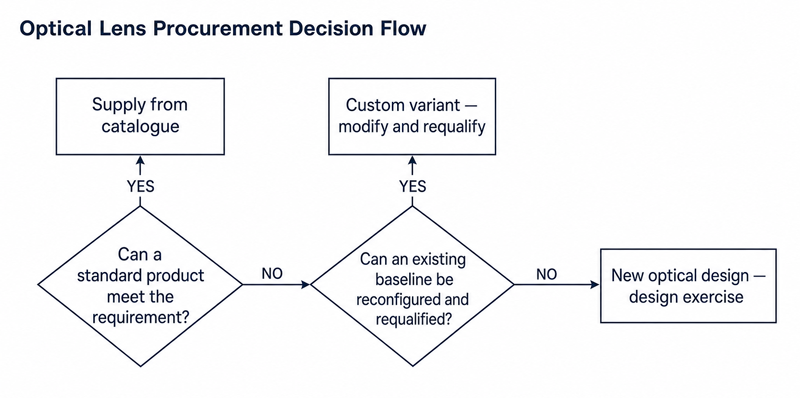
Non-technical considerations can be important too and often decide the matter before the optics do: ITAR-free status, export compliance of the design, and who owns it when the work is done. An informal discussion at the outset establishes scope and viability before either side commits effort to a quotation.
What a Standard Figure Means
A quoted figure is usually one of three things:
- Design intent: what the optical model predicts for a unit built exactly to drawing, with no tolerance stack-up. It is a target, not a measurement.
- A typical value: measurements taken from real units to provide a representative result, not a limit.
- A production tolerance: the band within which every delivered unit is held and the only one of the three you can put into a worst-case error budget.
The distinction matters most for boresight, because that is where the lens consumes part of the system pointing budget — the total angular error permitted between where the system reports it is looking and where it is in fact looking. The lens must hold the share allocated to it.
Beck's ruggedised 13-286 mm VIS/NIR zoom is specified at ±0.1 mrad boresight retention, held through the full range of zoom and focus travel. Retention is verified on an MTF bench using a collimated target and reference sensor, on a sampling basis as standard, with per-unit verification available where a programme's pointing budget requires it. That the figure is quoted across the travel rather than at a single focal length is the substantive part: boresight error varies as the zoom and focus groups move, and a single-focal-length figure says little about an assembly that spends its working life sweeping between 13 and 286 mm.
Changing waveband changes the prescription. Beck's SWIR zooms are designed in the SWIR band with glass selection and chromatic correction computed in-band, rather than visible designs with SWIR coatings applied. Where a supplier's visible and SWIR products share a focal range, it is not unreasonable to ask which was designed first.
Three Variables That Tell You What a Figure Means
- Typical, design intent, or verified? A per-unit tolerance is a specification. A typical value describes a population, and worst-case analysis will need a different number.
- Across what mechanism range does it hold? For a zoom assembly, a boresight or MTF figure quoted without a stated range of zoom and focus travel is incomplete.
- Measured at the quoted temperature, or modelled? Optical metrology is normally carried out at an ambient temperature, so figures spanning a range are usually an ambient measurement plus a thermal model, with function confirmed at the limits during environmental testing.
Case study: extending the lowest working temperature to -25°C
A customer required a 13-286 mm assembly for an airborne surveillance platform with a lower operating limit of -25°C, against a standard rating of -20°C. Five degrees doesn’t look much on a specification list, but two distinct effects set in as temperature falls.
The first is optical. Refractive indices shift, components contract at differing rates, and the optical axis moves relative to its mount. The boresight tolerance has to absorb all of it, so the variant is specified at ±0.5 mrad from -25°C to +70°C, five times the standard figure, across a broader band. At one kilometre that is the difference between roughly 100mm and 500mm of uncertainty, which is why the allocation merits negotiation rather than acceptance.
The second is mechanical, and is more often overlooked at system level. Lubricant viscosity rises, mechanism drag increases, torque margin declines. The result is rarely a failure to zoom but a slower zoom. Unheated, this assembly slows appreciably below about -15°C: zoom time extends to roughly 12 seconds at −25°C against a 10-second specification, and to 17 seconds at -30°C. Our response on this programme was to fit heaters, drawing platform power through a customer-specified connector.
Warm-up time is the figure integrators ask for next, and it is worth being careful what it can mean. A lens is rarely thermally isolated from its mount. An assembly bolted to vehicle or airframe structure sitting at -20°C is in continuous thermal exchange with it, and a bench warm-up figure will not survive that installation. The useful question is not how long the lens takes to warm, but what the mount is doing to it. This is a system-level question rather than a lens one.
An extended temperature range costs angular pointing allocation, because more thermal drift means a looser boresight figure and a larger share of the pointing budget. It also costs electrical power, because holding mechanism timing at low temperature needs motor torque, and heaters if the timing is to be held rather than relaxed.
Which Requirements Need a New Design, And Which Do Not
The airborne variant retained the 13-286mm focal range, the 400-1,100nm waveband and the chassis. What changed was the environmental envelope, the boresight allowance and the addition of thermal management. The customer specified a vibration Category 20 requirement, and Beck addressed this with a finite element analysis of the assembly against worst-case load figures.
Envelope change: usually absorbed by a variant | Prescription change: usually needs optical redesign |
Operating and storage temperature | Focal range |
Vibration and shock category | Waveband |
Sealing and ingress protection | Aperture |
Mechanical and electrical interface | Image format |
Tolerance allocation | Overall packaging |
Thermal management |
The limit is mechanical rather than optical. Chassis, electronics and mechanisms are common across the range, and within a waveband what changes between models is the rear lens group and the camera mount. That commonality is what makes the middle route less expensive: an envelope change reuses a proven mechanism, and existing environmental evidence carries across, so effort concentrates on what actually changed.
Envelope parameters are addressed through material and lubricant selection, sealing, heaters, mount design and, most significantly, reallocation of tolerance. The optics are unchanged; what changes is what is asked of them and how much error is permitted.
Prescription parameters govern glass selection, element count and group layout. These are interdependent, so altering one moves the others, and the optical performance of the result has to be established rather than inherited. Because the mechanism is common, that work is narrower than a design from scratch, but it is design, and it carries its own non-recurring cost.
When an enquiry arrives and a standard product will not meet it, we separate the requirement into these two columns. Where everything unusual falls on the left, a variant may reasonably be requested and the discussion will concern tolerance allocation and test evidence. Where anything falls on the right, expect a development conversation.
Working with Beck
The three routes are not three products but one engineering conversation held at different depths, and the answer is usually available following a single discussion.
Beck's ruggedised zoom range covers VIS/NIR and SWIR, supplied as catalogue assemblies, as requalified variants and as customer-specific developments. Optical design, mechanical design, assembly, and environmental and MTF testing are carried out at the Beck Optronics Solutions facility in Hertfordshire, UK. This is what allows a variant to be scoped and qualified without design and test evidence sitting with different suppliers. For defence and aerospace programmes it is also a sovereign UK and ITAR-free route.
Our datasheet figures are written to be used in an error budget rather than read in a comparison: boresight retention quoted across the full zoom and focus travel, verified against a collimated reference, and specified across the environmental range the assembly is rated for. Tell us which parameters differ from the published specifications and we will tell you which of the three routes that puts you on, what it costs in pointing allocation and electrical power, and what evidence comes with the delivered unit.
If your requirement differs from a published specification in ways you are not sure how to classify, get in touch today for an informal discussion. We will tell you which of the three routes it puts you on before either side commits effort to a quotation.
Frequently Asked Questions
Is a custom lens assembly always a new optical design?
No. It can be a catalogue product, a requalified variant of an existing chassis, or a new design. The route depends on which parameters fall outside the standard baseline, not on how demanding the specification appears.
What does a boresight figure on a datasheet actually mean?
It may be design intent, a typical value, or a verified production tolerance. Ask which of the three you are being quoted, across what range of zoom and focus travel it holds, and whether verification is per unit or on a sample.
Why does extending the operating temperature range affect boresight?
Refractive indices shift and components contract at different rates as temperature falls, moving the optical axis relative to its mount. A wider range therefore usually requires a looser boresight tolerance, increasing the lens's share of the pointing budget.
What documentation should accompany a variant assembly?
Establish it at enquiry stage. A certificate of conformity attests conformity; a test report contains the data. If your qualification dossier needs data, ask for the report before delivery rather than after.